
Most facilities teams think of automatic door operators as an ADA checkbox, required in certain openings, installed to meet code, and never thought about again. But getting the most out of operators about treating them as a usability decision rather than a compliance action.
Getting there requires understanding what ADA mandates, which is often misread in both directions. Some teams over-specify because they assume any accessible entrance needs an operator, while others under-specify because a door technically passes inspection without one. Most teams skip the follow-on question entirely: where else would an operator make life better even when it is not required?
What ADA Requires for Door Operation
ADA does not require automatic operators on every door; what it requires is that doors meet specific usability thresholds. The regulation sets the performance standard, the hardware is how you get there.
Those thresholds include:
- Maximum 5 pounds of opening force for interior doors (fire doors carry separate allowances)
- One-hand operation with no tight grasping, pinching, or twisting of the wrist
- Hardware mounted at compliant height with adequate clearance and maneuvering space on both sides
- Lever-style or push/pull hardware that meets shape and design standards
When a door cannot meet those thresholds through passive hardware alone, whether because of door weight, closure force, configuration, or wind load, an automatic operator becomes the solution. The trigger is not the type of facility or the population it serves. It is whether the door performs to the standard without one.
Low Energy vs. High Energy: What Most Commercial Facilities Need
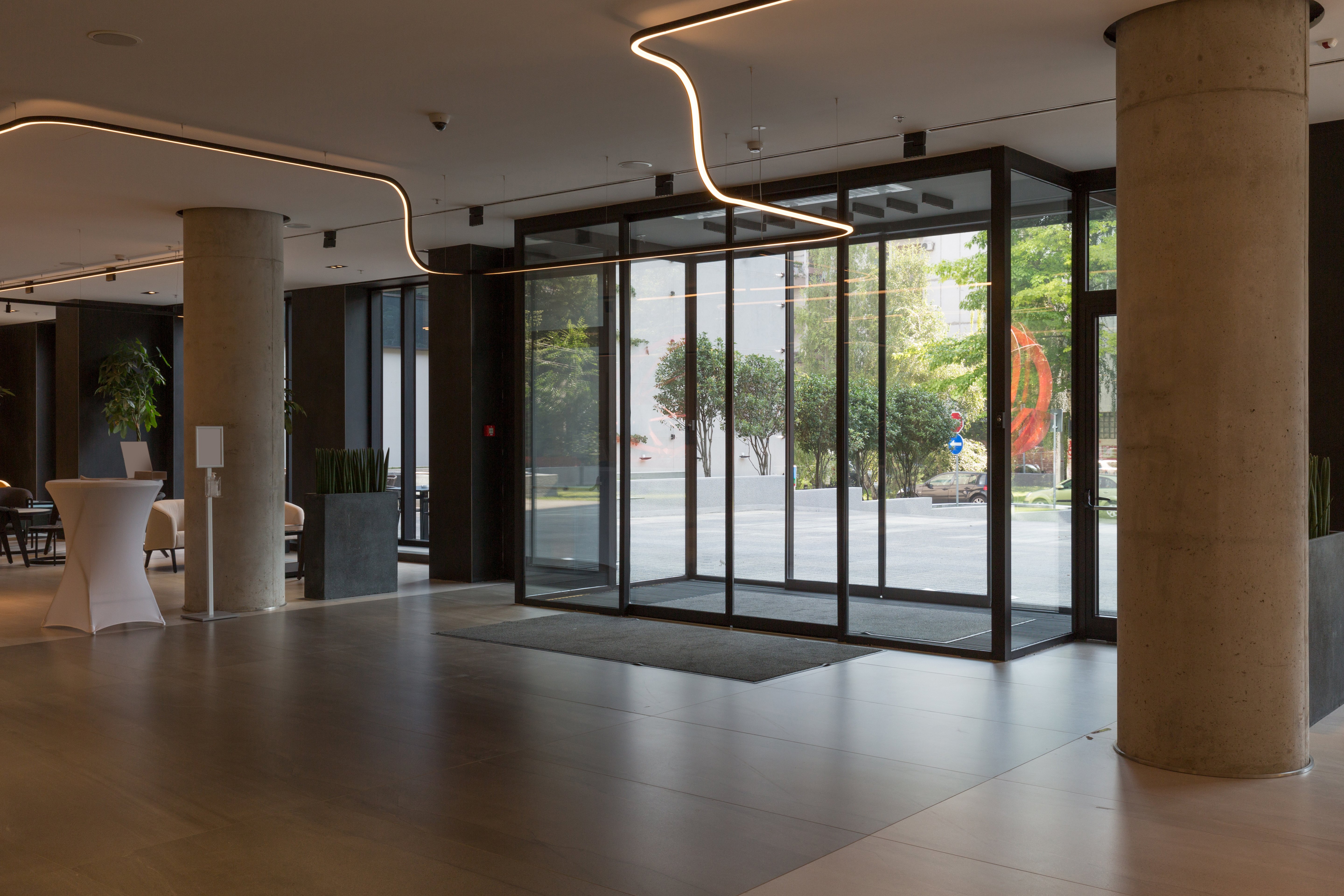
When facilities teams hear "automatic door operator," many picture a grocery store entrance. Doors that swing or slide open as you approach, running continuously, with sensor arrays overhead. That is a high-energy operator, and it is almost never what a typical commercial (non-retail) facility needs.
S.A. Morman primarily installs low-energy operators, and for most commercial applications, they are the perfect fit. A low-energy operator activates on demand, triggered by a push button, wall switch, or credential. The door opens at a controlled speed and closes on its own. If it contacts an obstruction, it stops and resets. It does not run continuously, does not require the same sensor infrastructure as a high-energy system, and is considerably simpler to install and maintain.
The distinction is important because overestimating what what kind of operator needed is one of the main reasons facilities teams hesitate to add them. Offices, healthcare facilities, educational buildings, and religious institutions are all low-energy use cases because the complexity and cost of a grocery store (retail) entrance does not apply. For more on how hardware decisions affect long-term door performance, the door hardware lifespan guide covers that in more detail.
Beyond Compliance: Why Automatic Operators Benefit Every User
ADA requirements exist because of past incidents and existing access barriers, but the usability improvements they drive benefit everyone. Automatic operators are one of the clearest examples of that pattern.
Anyone carrying equipment, pushing a cart, or managing an armload of materials gets the same benefit as someone using a mobility device. One person activates the operator, and the next several walk through without touching anything. In healthcare and senior living, operators reduce physical strain for patients, visitors, and staff moving between areas throughout the day. In education, they improve traffic flow during class changes and reduce bottlenecks at high-volume entrances.
There is also a hygiene dimension that has become harder to ignore. Reducing touchpoints on high-traffic doors has measurable value in healthcare, food service, and any facility that manages infection control. A push-button operator on a restroom or kitchen entry is not an accommodation, but a reasonable infrastructure decision. For a broader look at how balancing design and functionality shapes hardware selection, that applies here as well.
Where to Start Evaluating Your Openings
Not every door needs an operator. The question is which openings would benefit most and where the compliance case is strongest.
- Main entrances and high-traffic entries are the obvious starting point, particularly where the 5-pound force threshold is difficult to maintain due to closure pressure or wind load.
- Openings where users regularly have full hands or are moving equipment, including loading areas, supply rooms, and kitchen entries, are strong candidates regardless of whether an operator is required.
- Openings serving populations with mobility considerations, such as patient wings, senior living common areas, and therapy rooms, where an operator reduces friction throughout the day.
- Doors where complaints about weight or difficulty are recurring, which is often a signal that passive hardware is not meeting the performance standard.
A site walk-through with someone who understands both ADA requirements and door hardware decisions is the most efficient way to identify the right openings without over-specifying.
S.A. Morman: The Right Operator in the Right Opening
The operator is only part of the decision. Mounting, wiring, activation controls, and integration with existing hardware all factor into whether the installation actually performs as intended. An operator bolted onto an opening without accounting for the full assembly is a common source of callbacks and adjustments that could have been avoided.
At S.A. Morman & Co., we've spent 165 years working with commercial door assemblies, and automatic operators are part of that scope. We assess which openings benefit from operators based on traffic patterns, use case, and compliance requirements, and we handle the full installation including the operator, mounting, wiring, and activation controls as a single scope. The goal is an opening that works correctly from day one, not one that requires follow-up because the operator and the hardware weren't specified together.
Contact S.A. Morman & Co. for an automatic door operator assessment.